
NEWS
United States Signals It Will Exercise Its Veto Power at the United Nations After Being Suspended Under Article 5 for Condemning President Donald Trump’s Unilateral Military Action in Venezuela and the Capture of President Nicolás Maduro

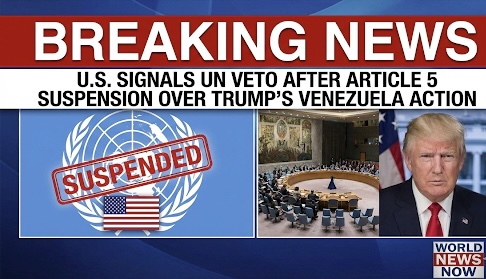
United States Signals Its Veto Will Shield It at the United Nations in Wake of Military Operation in Venezuela
In early January 2026, the United States’ military capture of Venezuelan President Nicolás Maduro sharply divided global opinion and thrust the U.S.–Venezuela crisis onto the world stage — particularly at the United Nations Security Council (UNSC). While the U.S. has not been formally suspended from the United Nations or “under Article 5” of the U.N. Charter — a provision not applicable in this context — it has made clear that as a permanent member of the UNSC it will exercise its veto power to block any resolution it views as punitive or condemnatory of its actions.
A Military Operation That Shook Diplomacy
On January 3, U.S. military forces carried out a strike in Caracas that resulted in the capture of President Maduro and his wife, Cilia Flores. Washington transported them to the United States to face longstanding criminal charges, including narco-terrorism and weapons trafficking allegations, which Maduro has consistently denied. 
The Trump administration described the operation as a “surgical law enforcement action” aimed at executing U.S. indictments against Maduro. U.S. Ambassador to the United Nations Mike Waltz defended the operation before the Security Council, insisting it did not constitute an occupation and alleging Maduro’s government was illegitimate. 
Storm of Condemnation at the U.N.
In emergency sessions of the Security Council, a broad coalition of nations — including traditional U.S. allies — criticized Washington’s move as a violation of international law and a dangerous precedent. France, Denmark, China, Russia, and multiple Latin American states warned that unilateral force against a sovereign government undermines the U.N. Charter’s core principles. U.N. Secretary-General António Guterres also expressed “deep concern” about the action’s potential to destabilize the region and weaken the rules-based international order. 
Countries such as South Africa and others outside the Western bloc openly condemned the operation as an “illegal act of aggression,” signaling that the world is deeply divided over Washington’s justification and purpose. 
Legal and Diplomatic Battleground
International law experts have been prominent voices in the debate, arguing that:
• The U.S. operation lacked UN Security Council authorization,
• It did not have Venezuelan consent,
• And it does not qualify as self-defense under Article 51 of the U.N. Charter. 
These issues strike at the heart of the U.N.’s mission to prevent the unilateral use of force except under narrow circumstances.
U.S. Veto Power: A Shield Against Accountability
While the Security Council can convene and discuss U.S. actions, any attempt to adopt a binding resolution condemning or sanctioning Washington faces a practical barrier: the United States is one of the five permanent members of the Council, each of whom holds veto power. This means that any substantive resolution potentially critical of U.S. conduct can be blocked by Washington itself. 
U.S. officials have implicitly and explicitly signaled they are prepared to use this veto power to prevent measures they deem illegitimate. In doing so, Washington underscores a long-standing structural reality of the U.N. Security Council: no binding action can pass over the objections of a permanent member, regardless of international condemnation or debate.
Implications for International Law and Multilateralism
Critics argue Washington’s readiness to wield its veto in this crisis reflects broader concerns about selective adherence to international norms and the resilience of the multilateral system. Detractors suggest that allowing powerful states to act with near-impunity undermines faith in the U.N. and risks encouraging other nations to pursue unilateral military strategies when convenient. Proponents within U.S. policymaking circles maintain that the veto — and U.S. membership in the Security Council — is necessary to protect national interests and prevent the U.N. from acting in ways that could constrain U.S. sovereignty or security operations. 
Conclusion: A Fractured Security Council and a Precedent-Setting Crisis
As the crisis unfolds, the United States stands at a diplomatic crossroads. Its wariness to allow binding criticism at the United Nations — backed by its veto authority — highlights both the strength and limitations of the current global governance architecture. Whether this episode will prompt broader calls for reform of the veto system or lead to further polarization remains to be seen. What is clear is that the U.S. intention to use its veto power will be a defining feature of the international response to the Venezuela crisis at the United Nations.

Look at 26 Serena Williams’ private pictures that dazzle everyone — Six talking points…

Serena Williams Stuns in These 6 SI Swim Photos in Turks and Caicos…

Serena Williams is the reminder that greatness doesn’t fade… it evolves…

Breaking : Serena Williams strikes a powerful pose in $1,000 cutout swimsuit…

When Serena Williams returned to tennis after becoming a mother, it wasn’t just a comeback…

Angel Reese Announces Career News Before WNBA Season she is making waves off the court ahead of the 2026 WNBA season….

Serena Williams shows off incredible bikini body at 44 and in best shape of life in summer-ready photoshoot…

Look at 26 Serena Williams’ private pictures that dazzle everyone — Six talking points…

NEWS UPDATE : Serena Williams Turns Heads Worldwide With Bold, Confident Style as Fans Celebrate Her beautiful Look and Powerful Influence Beyond Tennis…

Look at 25 Serena Williams’ private photos that’s dazzled everyone…

3 private Serena Williams mouth-watering beach photos are causing serious damage to her fans…
