
NEWS
International Criminal Court Set to Open Investigation Into Alleged Crimes of Aggression, War Crimes, and Violations of Sovereignty Following Donald Trump’s Military Attack on Venezuela and the Capture of it’s Sitting President, Nicolás Maduro

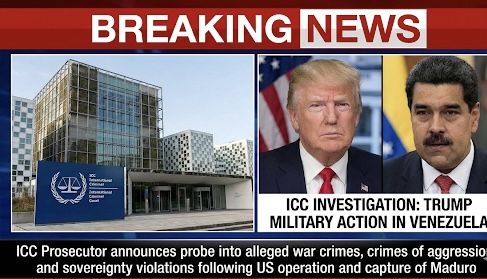
International Criminal Court Set to Face Pressure Over Possible Investigation Into Alleged Crimes of Aggression, War Crimes, and Violations of Sovereignty Following U.S. Military Attack on Venezuela and Capture of President Nicolás Maduro
January 7, 2026
In the wake of a stunning and highly controversial U.S. military operation that resulted in the capture of Venezuelan President Nicolás Maduro and his transfer to the United States, international legal authorities, governments, civil society, and legal experts are calling for the International Criminal Court (ICC) to examine whether grave international crimes — including aggression, war crimes, and violations of sovereignty — may have occurred.
The U.S. Military Operation in Venezuela
On January 3, 2026, the United States carried out a large-scale military strike against Venezuela, according to statements from the White House. U.S. forces reportedly captured President Maduro and his wife, flying them to New York where he was arraigned on federal narcotics and terrorism-related charges. U.S. President Donald Trump described the mission as a success and part of a broader effort to confront alleged narco-trafficking and “run” Venezuelan governance.
The Venezuelan government and many international critics condemned the operation as an act of military aggression and a flagrant violation of Venezuelan sovereignty and international law. Diplomatic condemnations poured in from Russia, Iran, China, and other countries, while the United Nations Security Council held emergency discussions on the crisis. 
International Legal Controversy and Claims of Illegality
International legal scholars and human rights observers have been sharply critical of the U.S. action. Many experts argue that Article 2(4) of the United Nations Charter, which prohibits the use of force against the territorial integrity or political independence of any state without Security Council authorization or a recognized right of self-defense, was violated. Such conduct, they assert, could constitute the crime of aggression, one of the gravest offenses under international law. 
Critics point to the absence of credible evidence that Venezuela posed a direct armed threat to the United States and reject Washington’s framing of the capture as a law-enforcement action. Noted legal analysts state that a unilateral military operation to depose a head of state without host nation consent or Security Council backing is a violation of international norms and may fall within the ICC’s jurisdiction for scrutiny. 
The ICC’s Mandate and Venezuela’s Pre-Existing Case
The International Criminal Court, based in The Hague, was established to investigate and prosecute persons responsible for genocide, war crimes, crimes against humanity, and the crime of aggression under the Rome Statute. While the United States is not a party to the Rome Statute and therefore not bound by full membership obligations, the ICC can exercise jurisdiction when crimes are committed on the territory of a state party — and Venezuela is a member. 
Prior to the U.S. action, the ICC already had an ongoing situation concerning Venezuela. Following years of reporting on political repression, excessive use of force against dissidents, and alleged crimes against humanity, the ICC prosecutor authorized pursuit of an investigation after concluding that Venezuelan authorities had not adequately addressed alleged internal abuses. 
This existing context has heightened expectations that the Court could now confront not only alleged crimes by Venezuelan officials but also potential international law violations stemming from the U.S. intervention.
Calls for ICC Scrutiny and Legal Debate
Legal analysts argue that there is now a compelling basis for the ICC’s Office of the Prosecutor to assess the recent conflict for potential crimes under the Court’s jurisdiction. This includes the crime of aggression, which relates to unlawful use of force by one state against another, as well as possible war crimes tied to civilian harm during the military operation. 
A recent legal commentary detailed how the ICC’s prosecutorial office may already be positioned to consider whether an arrest warrant or formal investigation could be appropriate. Under Rome Statute procedures, any action by the prosecutor must be legally justified, and preliminary analysis can lead to a request to a pre-trial chamber for authorization. That decision would hinge on available evidence and legal thresholds being met. 
However, legal challenges remain. Because the United States is not a party to the Rome Statute, prosecuting U.S. leaders poses significant legal and diplomatic complications, particularly given Washington’s long-standing opposition to ICC jurisdiction. Historically, the Trump administration has sanctioned ICC judges and prosecutors over past investigations involving U.S. allies, raising questions about how the court would proceed with an investigation involving U.S. conduct. 
International Reactions and Calls for Accountability
Governments around the world have taken sharply divergent positions since the Venezuelan operation. Many Latin American and global actors condemned the use of force and urged respect for international law. Others cautiously acknowledged Maduro’s removal but warned against eroding norms that prevent unilateral military intervention. 
Civil society groups and human rights organizations have called for independent investigations, including by the ICC, to ensure accountability for all serious violations, regardless of the nationality of the perpetrators or the geopolitical implications.
Conclusion: A Defining Moment for Global Justice
As the geopolitical reverberations of the Venezuelan military operation by the United States continue to unfold, international legal institutions — and the ICC in particular — face pressure to clarify the limits of lawful conduct between states and to uphold the statutes that govern the most serious crimes of global concern.
Whether the ICC ultimately opens a dedicated investigation into alleged crimes of aggression or other violations linked to the U.S. intervention remains uncertain. What is clear, however, is that the principles of sovereignty, non-aggression, and international law are at the heart of a contentious global debate — one that will echo in courts, capitals, and diplomatic forums for months and likely years to come.

Look at 26 Serena Williams’ private pictures that dazzle everyone — Six talking points…

Serena Williams Stuns in These 6 SI Swim Photos in Turks and Caicos…

Serena Williams is the reminder that greatness doesn’t fade… it evolves…

Breaking : Serena Williams strikes a powerful pose in $1,000 cutout swimsuit…

When Serena Williams returned to tennis after becoming a mother, it wasn’t just a comeback…

Angel Reese Announces Career News Before WNBA Season she is making waves off the court ahead of the 2026 WNBA season….

Serena Williams shows off incredible bikini body at 44 and in best shape of life in summer-ready photoshoot…

Look at 26 Serena Williams’ private pictures that dazzle everyone — Six talking points…

NEWS UPDATE : Serena Williams Turns Heads Worldwide With Bold, Confident Style as Fans Celebrate Her beautiful Look and Powerful Influence Beyond Tennis…

Look at 25 Serena Williams’ private photos that’s dazzled everyone…

3 private Serena Williams mouth-watering beach photos are causing serious damage to her fans…
