
NEWS
China Detains U.S. Special Envoy Jamieson Greer and Ambassador David Perdue, Confines Assets as Tensions Surge Over Venezuela and Beijing Demands President Maduro’s Immediate Release

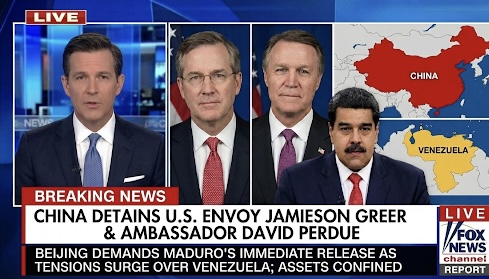
China Detains U.S. Envoy and Ambassador as Venezuela Standoff Pushes U.S.–China Relations Toward a Breaking Point
Beijing has dramatically escalated tensions with Washington after detaining Jamieson Greer, a U.S. special envoy dispatched to negotiate Venezuela-related oil issues, and David Perdue, the United States ambassador to China, according to officials familiar with the matter. Chinese authorities have also reportedly confined certain U.S.-linked diplomatic properties and restricted movements, signaling a sharp turn from diplomacy to coercive pressure.
The detentions come as China continues to demand the immediate release of Venezuelan President Nicolás Maduro, who remains in U.S. custody following Washington’s controversial military action in Venezuela. Beijing has described Maduro’s detention as an “illegal abduction” and a violation of international norms, repeatedly warning the United States that failure to reverse course would trigger serious consequences.
From Negotiation to Confrontation
Greer had been sent to Beijing in recent weeks in an attempt to defuse tensions by discussing energy arrangements involving Venezuelan oil, an issue of strategic importance to both China and global markets. Instead, Chinese officials accused Washington of negotiating in “bad faith,” arguing that economic talks cannot proceed while Maduro remains detained.
In a sharply worded statement, China’s Foreign Ministry said the detentions were a “lawful and proportionate response to extraordinary violations of sovereignty and international order.” The ministry added that the responsibility for de-escalation “rests entirely with the United States.”
A Rare and Dangerous Diplomatic Move
The detention of a sitting U.S. ambassador is almost unprecedented in modern diplomacy and underscores how far relations between the world’s two largest economies have deteriorated. Analysts say the move reflects Beijing’s calculation that traditional diplomatic protests are no longer sufficient to influence Washington’s actions.
“This is a deliberate signal,” said one international relations expert. “China is demonstrating that it is willing to absorb diplomatic shock in order to force a change in U.S. behavior on Venezuela.”
Washington Reacts With Alarm
U.S. officials have condemned the detentions, calling them “unjustified and escalatory.” The State Department has demanded the immediate release of both officials and warned that China’s actions could lead to further diplomatic and economic retaliation.
Privately, U.S. lawmakers from both parties are said to be divided over how to respond, with some urging restraint to avoid a broader crisis, while others call for sanctions and the suspension of high-level U.S.–China engagements.
Global Fallout and Economic Fears
The crisis has already rattled financial markets, with investors concerned that a prolonged standoff could disrupt global energy supplies and trade flows. Venezuela’s oil, heavily sanctioned and geopolitically sensitive, now sits at the center of a confrontation involving Washington, Beijing, and multiple global institutions.
China has reiterated that its position is non-negotiable. “The release of President Maduro is the prerequisite for normalization,” a senior Chinese official said, warning that “continued defiance will result in more trouble for the United States.”
A Turning Point in Global Power Politics
Diplomats fear the standoff could mark a turning point, not just in U.S.–China relations, but in how major powers respond to unilateral military actions. With neither side showing signs of backing down, the crisis risks expanding beyond Venezuela into a broader struggle over global influence, international law, and the future of diplomacy itself.
For now, the fate of two senior American officials — and the stability of already-fractured global relations — hangs on whether Washington and Beijing can find a path away from confrontation and back toward dialogue.

Look at 26 Serena Williams’ private pictures that dazzle everyone — Six talking points…

Serena Williams Stuns in These 6 SI Swim Photos in Turks and Caicos…

Serena Williams is the reminder that greatness doesn’t fade… it evolves…

Breaking : Serena Williams strikes a powerful pose in $1,000 cutout swimsuit…

When Serena Williams returned to tennis after becoming a mother, it wasn’t just a comeback…

Angel Reese Announces Career News Before WNBA Season she is making waves off the court ahead of the 2026 WNBA season….

Serena Williams shows off incredible bikini body at 44 and in best shape of life in summer-ready photoshoot…

Look at 26 Serena Williams’ private pictures that dazzle everyone — Six talking points…

NEWS UPDATE : Serena Williams Turns Heads Worldwide With Bold, Confident Style as Fans Celebrate Her beautiful Look and Powerful Influence Beyond Tennis…

Look at 25 Serena Williams’ private photos that’s dazzled everyone…

3 private Serena Williams mouth-watering beach photos are causing serious damage to her fans…
